“Always be a first rate version of yourself, instead of a second rate version of someone else.”
– Judy Garland
Manhattan, 1950. The streets are damp and foggy with mists of a late-night drizzle, and the air is brisk against your skin as you meander along the sidewalk. The city famous for never sleeping, has fallen asleep, ceding its commanding presence to the mystical early morning hours. A time of day that is no longer “tonight,” but not yet “tomorrow,” a time of day whose place is not on a calendar.
Alone. A state of being that is always rare in the city, but it is where you find yourself as you continue your late-night journey. The sound of your footsteps echoes off the cold concrete, and the cigarette you are smoking has just burned down. You flick it away; as it falls to the ground, something hits you.
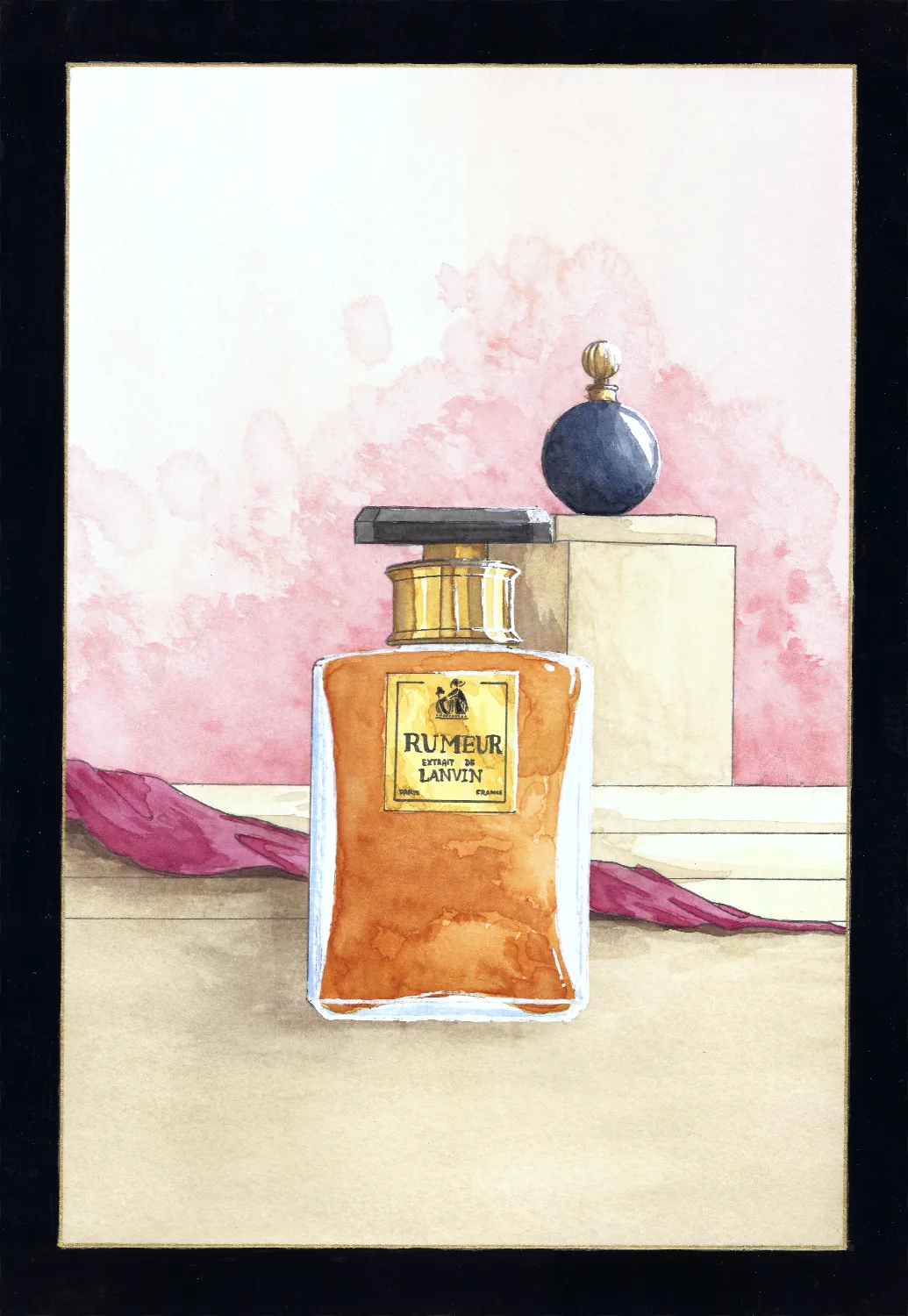
It was not a physical hit, no, you would have run. It was not a sound. You go through your senses before realizing it was a scent, a presence. A scent so captivating, so dainty, yet so intimidating, that it draws you nearer to its wearer. But what is it? No. 5, Shalimar, Scandal, even Vol de Nuit? No, you’ve heard talk of what this could only be, Lanvin Rumeur.
This article is the fourth entry in my exploration of the legendary lost fragrances of Lanvin (prior articles here). Let’s unpack its history, context, and hopefully discover its secret to desire.
The Best Paris has to Offer
Famous for her effortlessly chic, intricate, and all-around beautiful designs, Jeanne Lanvin was one of the 20th century’s most renowned designers. The house she founded over 130 years ago is still one of France’s premier couture houses, and her impact and story are ones for the ages.
A story I have written an article about, click here to read more about Jeanne and the history of Lanvin.

source Wikimedia

The 1920s was a decade that saw a rush of new and exciting products, brands, and ideas.
Jeanne no doubt took note of all the novelties and embraced those new ideas, while holding firm to her old-world sensibilities. This quality drove Jeanne to command the company to unprecedented heights. Throughout the decade, Lanvin would expand into a wide range of markets and product categories, with Jeanne’s keen eye being the wind in its sails.
No other department in the house better reflected this success than the fragrance line, and by the end of the 1920s, Lanvin had an impressive lineup. Following the smash hit of Arpège in 1927, Andre Fraysse would become the in-house perfumer for the company. Under his guidance and vision, the company would go on to have one of the most successful and masterful product runs of any fragrance house in history.
In 1931, Fraysse would introduce his first fragrance in this role, Scandal. A leathery and evocative composition that is still, to this day, held as one of the best leather compositions ever produced. All the more impressive when accounting for the struggles he undoubtedly faced due to the changing market conditions.
For his next composition, however, the landscape would be much darker.
The Light Amongst the Darkness


When Andre Fraysse launched Scandal in 1931, the throes of the Great Depression had not fully taken root.
That was not the only battle Fraysse faced when he was composing Scandal, however. As the economic future looked uncertain for a vast amount of the Western world, fashion would begin its pendulum swing of change as well. Quoting from my article on Scandal (read here):
“By the time of Scandal’s launch in 1931, the culture around fragrance and fashion had already begun shifting into the styles we would see become popular during the rest of the decade. Amongst the fashionable elite, the desire for avant-garde daring fashions waned, as they began to embrace a more polished and glamorous style. The androgynous beaded gowns of the 1920s fell aside, and the bias-cut skin-clinging glamor of the 1930s would find its first foothold in these early years of the decade. Still, the desire to push the envelope and experiment with individuality and sensuality remained, and it was this small flame that Fraysse would attempt to stoke with Scandal.”
Although Fraysse successfully rode the line between avant-garde and traditional with Scandal, by 1934 that line had all but disappeared. By then, the idealized glamor of Hollywood had taken over the cultural zeitgeist. In the ’20s women found strength in subverting expectation; the 1930s woman found hers in setting her own expectations. Sensual, bias-cut satin gowns, the soft curled hair, and the radiantly soft faces of the women that graced the silver screen completely eclipsed the androgynous fashions of the prior decade. All the while, onlookers affected by the economy sought solace in dreaming of a level of glamor just out of reach for them.
For Andre Fraysse, meeting these new expectations and demands, while continuing to innovate, would prove the ultimate challenge. Does Rumeur succeed?
Cracking the Mystery
Rumeur was originally launched in 1934, and was sadly discontinued in the early 1970s when Lanvin Parfums was acquired. It was very briefly relaunched in the early 1980s before being forever lost to time.
Throughout its life, Rumeur was available in a few concentrations. Most notably the extrait and Eau de Lanvin forms, but was also available as a spray in the 1960s. The Eau de Lanvin formula was a more lightweight composition of the extrait, similar to what we would consider an Eau de Toilette composition today.
For this review, I will be using a 1960s-era extrait bottle of Rumeur.
Now, let’s see if the rumors were true about Rumeur.


As I open my bottle of Rumeur, I am hit with the intangible sense of intrigue.
Its soft voice beacons out to me to follow it, and without second thought I do. The trail takes me to a richly decorated, old-world boudoir. Warm wood paneling, yellowed paintings, and plush furniture occupy the space in front of me. It is here I am inundated with the most delicious of top notes, a rich blend of fruits. On my skin, I pick up a rich plum, warm peach, and a sprinkle of something aldehydic to add the slightest bit of of zest.
Rumeur’s older sister, Arpège, had a similar start to its composition. In Arpège, this bounty of fruits presented itself in a fresher, more juicy way. Like a fresh picked peach out of a garden. In Rumeur, however, the fruit smells as if it has been baked into some densely packed dessert. Warm, sensual, spicy, and slightly sweet, yet still tart and perky. I may have wandered into this place in search of answers, but I am staying because of the feast ahead of me.
As I sink into a satin-upholstered chaise, the smoothness of the plum slides me deeper into the composition. At this stage, the mid notes take over and cloud out my better judgement. The notes I detect are rich, dense, resinous, and above all, spicy. I get the same superbly rich jasmine note that Joy has in it, and I can almost swear I detect a hint of carnation. Cardamom and nutmeg are also major players here, and I detect the ever slightest hint of cinnamon. They almost give a slightly “Christmas” vibe to the spice blend, but that is not the message Rumeur is delivering. Rather than smelling joyous and festive, the notes smell weighted and diffused, almost like incense burning the background.
As the plum dessert fattens me up, and the spices soothe my mind, before I can even realize it, the base notes wrap themselves around me like vines around a pillar. It is here where Rumeur reveals its most dangerous, yet delectable, secret power. At this stage, I am washed over with the warm inky quality of oakmoss, the powdery greenness of vetiver, and a pinch of smoky tobacco and balmy sandalwood. They are all powdery, washed out, and oh so sensually smooth. It all sort of comes together to envelop me and make me feel completely overcome with its power and might.
Yet, just as Rumeur has me in its grasp, it lets go. All these notes blend together and become what I can only describe as an ethereal haze, a sheer gauze that has decided my body would be a suitable host. It is as if I blinked, and I am no longer in that boudoir, but back out on that hazy street where I first smelt Rumeur. Although this time, I no longer need to wonder who that enigmatic person is wearing this composition, because that person is now me.
An Undefinable Composition
Try as I might, I do not think I will ever be able to get a full understanding of Rumeur’s composition. It seems every time I wear it, I uncover something new to love about it.
That quality, however, is what makes it such a masterpiece, and, in my opinion, the quintessential chypre. Rumeur has all the notes I’d expect from one, but it also has that veil of mystery and intrigue. An inability to really nail down what the composition is doing. It is the one singular trait I have found in all my favorite chypres, and out of all of them, Rumeur does it best. Some mysteries are just not meant to be solved.
Rumeur was created in its initial run from 1934 to 1971, then briefly relaunched from 1979 to 1982. Its launch was yet another strong pillar in the house of Lanvin and was another masterwork for the company. With the market’s needs met yet again, Andre Fraysse would begin composing the next, and final interwar Lanvin fragrance, Prétexte, which we will look at in the near future.
Until then, I will leave you. As always, thank you for reading and I hope that you enjoyed. I welcome you to share any thoughts/experiences you have with Rumeur.
– Zak
Gallery


Leave a Reply