“Perfume is a mark of female identity and the final touch of her style.”
– Christian Dior
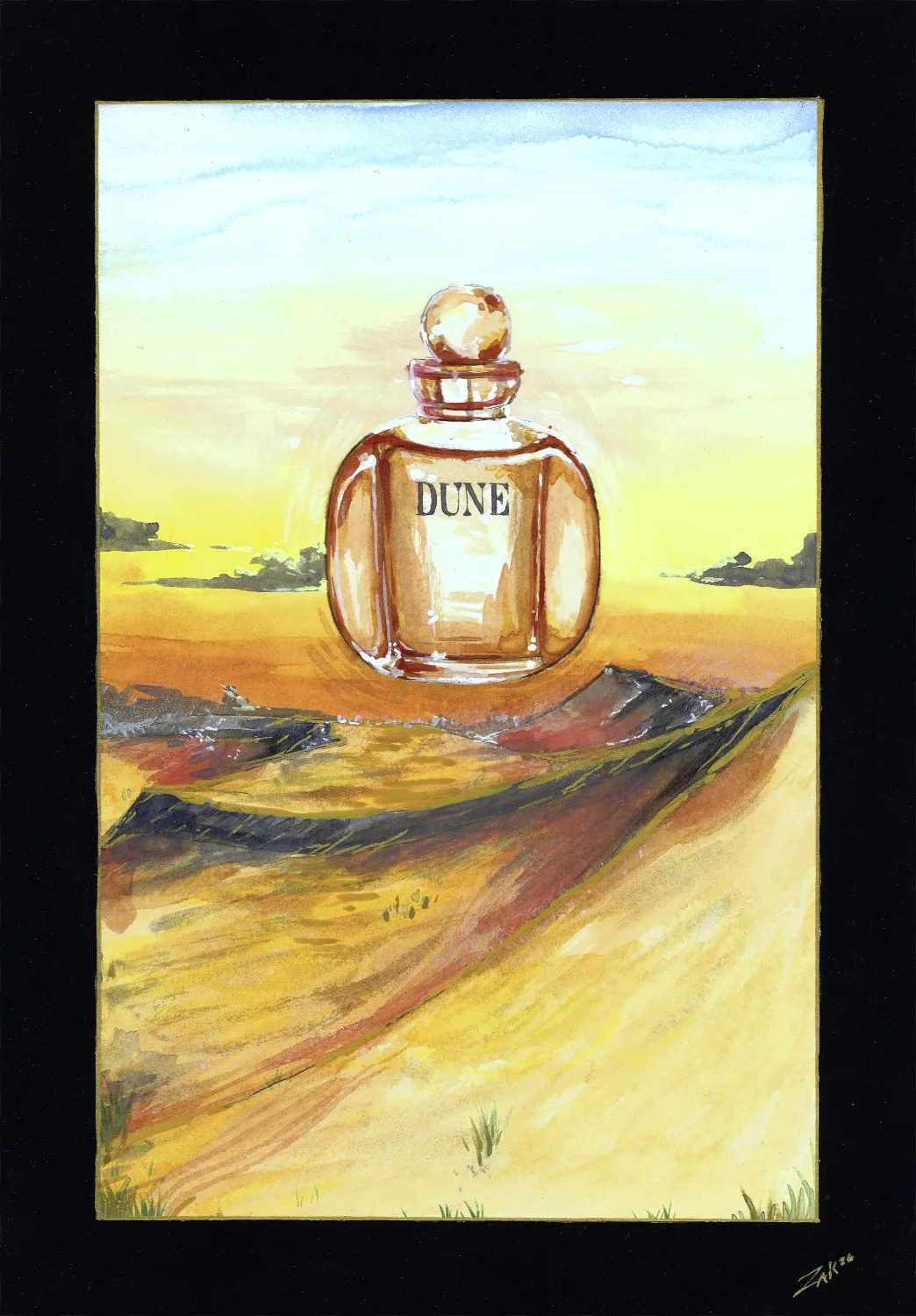
A large, open, tranquil seaside beach extends in front of you to the horizon. Decades ago, its shifting sands were enjoyed by countless visitors enjoying the sun. Now, it sits empty, having been left behind for more interesting or exotic locales.
The midday sun cascades its intense rays down around you, nearly blinding you as they reflect off the sand. A soft breeze rolls off the ocean’s waves and gently wraps itself around you like silk. With each step you take, the hot sand beneath you shifts, and the silence of the beach becomes more apparent. The desolation and isolation are unnerving.
The large, rolling dunes that surround you are filled with stories and histories. Numerous stories that have been eroded by time and are now only small granules of sand piled high around you.
Like the beach that surrounds you, no object, art, or even memory is immune to time’s withering touch. Statues crumble, history is forgotten, and styles come and go with each passing year. In this way, fragrances are much the same. What was once a best-selling, groundbreaking composition becomes a dated and unpopular box on a low shelf, or even worse, hidden in a drawer.
Dune, Dior’s opening salvo to the 1990s, was that unpopular box on the shelf when I bought it years ago. What has time done to it?
A Pillar of French Excellence
When Dune was released in 1991, the legendary French fashion house of Dior had long established itself as a benchmark in French luxury, design, and culture.
Founded in 1946 by master designer Christian Dior, Dior was one of the first French design houses to gain prominence in post-war Europe. Prior to the war, Christian had a long history working in the arts, having been interested in them from a young age. His start in the fashion world would not come until later, when he was hired by Robert Piguet as a designer. Later he also designed for Lucien LeLong during the war after his military service.
Following the war, Christian decided to open his own fashion house, and his first collection in 1947 was a pivotal success, not only for the newly founded house, but for post-war fashion in general.


Since the house’s beginning, Dior has always recognized the pivotal role fragrances play in a woman’s wardrobe. The first launch by the house, and arguably their most famous, occurred in the same year as that pivotal first collection. Miss Dior was launched to great success and laid the groundwork for all the compositions that followed.
Over the next few decades, Dior would go on to release many more compositions that further entrenched the house’s status in the industry. Diorissimo (1956), Eau Sauvage (1966), Dioressence (1969), and Diorella (1972) all proved to be smash hits for the brand. Yet these all paled in comparison to the runaway success of their 1985 release, Poison.
The launch of Poison came at the perfect time for Dior. At the start of the 1980s, changing tides not only in fashion but also in the beauty and fragrance industries threatened to leave the legendary house firmly entrenched in the past. Poison took the market by storm and would become a cultural touchstone for the decade as one of its most successful fragrances.
Yet, that popularity came with a price. By the end of the 1980s, the bombastic and outrageous style that had dominated the decade had already begun to wane in popularity. By 1991, the market was ready to move on, and Dune would be there to meet that demand. However, although it met that calling at the right time, Dune never reached the iconic heights that its predecessor achieved. Why is that?
At the start of each decade, I have always noticed a small micro-trend that occurs in pretty much all aspects of art, culture, and trends in general. A brief moment where the prior decade’s cultural dominance has noticeably died, yet the new decade has not developed its own distinctive culture and trends. For perfumery, this has shown up time and time again. By the early 1990s, the era of big, room-filling bouquets had died down, and a more minimal trend in florals had taken over, notably, a trend towards woodsy-florals. Dune falls in this category, but it is not alone, joined by compositions such as Guerlain’s Samsara, Patou’s Sublime, and the then newly reformulated Arpége. Although Dune (and its woodsy brethren) proved to be sales successes for their respective houses, they were soon eclipsed. Only a few short years later, Mugler’s Angel would launch and jumpstart an entire genre of fragrances in its wake, and other compositions like L’Eau d’Issey and CK One would join it and become the cultural trendsetters for the decade.
Although not a failure by any means, Dune would end up lost in the wake of the fragrances that came after it, the composition never fully fitting the trends of the decade it was launched in. Eventually, Dune would wash ashore and be buried amongst the sands for which it was named. However, time has a funny way of making what was old and forgotten new and unique again.
Over 30 years have passed since Dune’s initial release in 1991. What treasures lie buried in its depths?
A Private Oasis
In the 30+ years since Dune’s release, there have undoubtedly been a handful of reformulations. Changes in regulations and ingredient availability mean that there is rarely, if ever, a constant to any composition in the industry.
Dune was originally available in two main concentrations, Eau de Toilette and Esprit de Parfum (as well as Parfum), in addition to a wide range of body and bath products. In my collection, I own two bottles of Dune: a modern EdT dated to 2021 and a vintage EdT dated to 1992.
For this review, I will be using my 1992 bottle.


Closing my eyes and applying Dune, the first thing that strikes me is not its beauty.
No, I am struck by a bone-dry warmth that no other composition in my collection can match. In Dune, this warmth does not hit you like a brick wall; instead, it dusts itself across your senses like an extremely fine silk grazing the skin. Rosewood is the first predominant note I sense; it provides the spicy and woodsy warmth that makes the opening feel like a wash of sunlight. While the rosewood warms the body, a juicy mandarin note braces the soul and evokes a delightful feeling of sunshine and summer days. Paired together, they do feel rather stark and brash, yet they are smoothed out by something that is soft and tender, peach perhaps? The overall effect feels distinctly hot and sun-baked, like the sweltering winds that rip across a desert landscape. Yet, a very slight sprinkling of aldehydes into the mix keeps the composition feeling elevated and breezy. It prevents the composition from going too far inland, planting its ozonic haze firmly on the beach.
As the breeze fades, the heart of Dune begins to beat after lying dormant beneath the sands for so many years. Here, the composition shows its classical coastal charms and aura, as if the fragrance is showing you memories of when life and joy flocked to its sun-bleached shores. In this moment, I am taken in by the gentle wafts of ylang-ylang. The note feels rich, wet, and softly sweetened in a way only a yellow floral can truly feel. Clinging to its radiance, a fine balance of white florals and other yellow florals provides a weighty density to the bouquet. In that mix, I can also detect the slightest hint of frangipani, adding further to that summery warmth.
The heart of Dune is the memory of a tropical paradise; it feels exotic and sensual. At the same time, it is recognizably fleeting and distant. As quickly as the heart unfolds itself, the memory of that paradise fades away, and you are left to bask in the base of the composition.
At this stage, the reality of this coastal oasis becomes more readily apparent. A beautifully lush blend of sandalwood, amber, and benzoin creates an intensely luminous base, almost like the red-hot sands themselves. It allows the composition to feel grounded and have a heft to it, while forcing it to not rest on its foundation, lest it be scalded by the heat. It is joined by the inky and aromatic nuances of oakmoss, and the skin-like depth of a very soft wash of musk and powder.
Although warm and sunny, Dune is not a tropical vacation in a bottle. It does not feel like mimosas under the sun, cabana boys, and the ocean breeze cooling the skin. No, Dune feels arid, hot, and as unforgiving as the sands themselves. There is no classical beauty to be found here, no easily accessible tropical escape from the world around you. Instead, Dune places you on an empty beach completely devoid of life and energy. The only inhabitants are the dried pieces of driftwood and the tufts of grass that sparsely populate the horizon.
In truth, the painting Dune paints is one of bleakness and isolation. However in that bleak outlook, lies Dune’s true unnerving beauty. Although it does not offer you a vacation in the tropics, it does offer something that no other composition can ever match. That is, an escape from life itself, and in that complete isolation Dune presents to you its secret treasure: an achingly gorgeous serenity and bliss.
Serenity Now
While Dune may have never reached the absolute heights like its predecessor Poison achieved six years prior, that time away from the limelight may have been Dune’s saving grace.
For, as beautiful as Poison is, it will forever be tied to the decade in which it was released. Dune, on the other hand, transcends its age and does not merely live in the shadow of its older sibling, but it basks in it and lives on as one of the most timeless underground classics in the fragrance world.
When I first approached Dune at that Dior counter all those years ago, I did not know what to expect from it. No matter what little expectations I may have had, Dune exceeded them tremendously. For that reason alone, it is, and will always be, my favorite Dior fragrance ever made.
As always, thank you for reading, and I encourage you to share your thoughts down below.
Until next time,
– Zak


Leave a Reply