On this blog, I have worked hard to create articles that are equal parts artistic as they are informative. It is part of my passion, and I enjoy doing it as an escape from the world. Sometimes though, my world is too busy to escape, and I end up not being able to meaningfully contribute to this site in the ways I want to.
So, in an effort to remedy that issue, I am starting a new category on this blog for shorter, less formal, and more personal posts and articles. I hope this not only gives me a way to contribute more to the ether that is the internet, but also helps me to personally feel more in-touch with my writing altogether. Although I love the videos and audience I have cultivated on my TikTok, my writing is and will always be my true passion project. Don’t worry though, the longer form articles will not be going away, they will just be supplemented with more content in general.
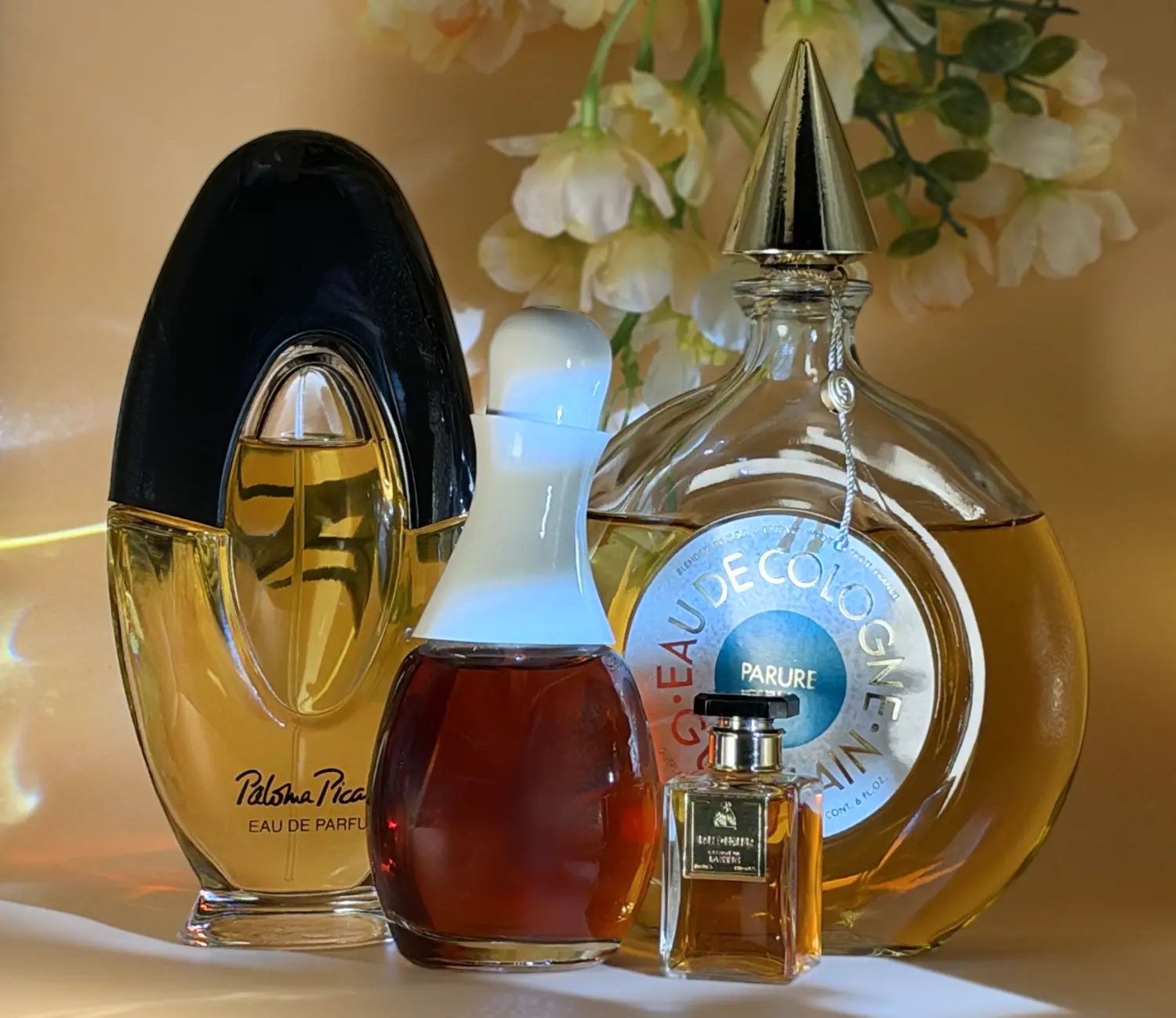
Now, with all that being said, I think the best way to inaugurate this new article style is to talk about some of my favorite compositions from one of the most legendary fragrance families in the world: Chypres.
Guerlain Parure

Composed and released in 1975 by Jean-Paul Guerlain, Parure never quite made the impact I believe it should have.
Parure is in some ways a difficult composition to wear, and even more difficult to describe. In the true fashion of old school perfumery, Parure is a dense blend of notes that make it nearly impossible to read. I can just pick out a few notes though. Namely, plummy fruits, very verdant green notes, indolic white florals, and an extremely biting and inky oakmoss note. That being said, simply listing out all the notes really does not tell you the full story.
You’d think all that density and depth would make this a heavy, rich fragrance, but you’d be wrong. Parure‘s magic trick is that it takes those notes, and somehow is able to remain unimaginably crystalline and crisp throughout its entire wear-time. Like an unbelievably clear-cut set of diamonds. In the same vein, that quality pulls Parure further away from the chypre family and towards a more green-floral-woody style of composition. In a strange way, it reminds me slightly of Vol de Nuit, but only very fleetingly.
Parure is difficult because it is difficult to categorize, which I think in turn made it difficult for the composition to find its footing amongst its contemporaries. Yet, that is also why I consider it one of my favorites.
Lanvin Rumeur
Ah, Lanvin’s 1934 masterpiece, Rumeur. My personal favorite from the house, and a fragrance I have covered before in one of my favorite articles I have ever written. To me, this is THE benchmark chypre that I compare all others to.
To put it very simply, Rumeur is single-handedly the most sensual and voluptuous chypre in my collection. At its start is spiced and roasted plum and peach notes, over top of warm spices, soft florals, balmy woods, and a hauntingly metallic oakmoss. Rumeur is one of the fragrances I use for reference as to what I should expect oakmoss to smell like. It is intensely wet and languid, while also having a piercing edge to it.
Combine that with the spice bomb qualities the rest of the composition has, and you get a very dark and mysterious composition. One that seemingly slinks in the shadows of your senses.
I genuinely do recommend reading my longer review that I wrote (and linked above). A simple few paragraphs barely scratches the surface of what this fragrance has to offer.

Paloma Picasso

Released in 1984, Paloma Picasso is the first fragrance by the famed designer, and daughter of the painter Picasso, Paloma Picasso. For this composition, she wanted a scent that was fiery, intense, and complex. Something that would match her style and personality.
The result is an incredible composition that has such an intriguing push and pull between crisp freshness and warm spiciness. On the freshness side you get bright aldehydes and citrus notes, on the other side you get pepper notes, a red and fiery carnation, and rich balmy woods. What ties the two sides together is an Earthy, almost medicinal/herbal base that keeps the overall composition grounded.
When everything is put together, the two sides seem to come to an agreement and you get a fragrance that is shockingly balanced and hyper refined. Also, it reads very uni-sex, but in a cool, chic, easy-going eaux de cologne way.
Halston
Released in 1975, Halston is, to me, the unofficial fragrance of Studio 54 and the disco era. In some ways, that makes a lot of sense, its note structure and overall style is very of its time. Having said that, I’d expect something more bombastic and in your face from that scene. A scene its namesake became thoroughly intertwined with.
You’ll be shocked to find that the overall effect of the composition is shockingly earthy and raw. Combined with a soft tender peach note, silky powders, and a very daring use of a marigold note, Halston is unexpectedly grounded given its reputation.
I’d like to touch on the marigold note in particular. This is the only fragrance in my collection that I am aware of containing that note, and it is simply strange. It reads slightly spicy, herbal, and has this strange ambery smoothness to it. Enhanced with some carnation and you get what I can only describe as a restrained fiery passion. Additionally, I have always gotten from Halston a honeyed undercurrent that tinges the composition with a touch of sweetness.
I think that restraint really does work in Halston‘s favor though, giving it this alluring nature that a bolder composition would not have. Like a supermodel in a slinky bias-cut gown.

Back to the Cabinet
Chypres are a fragrance family that can be difficult to understand and to describe. At the same time, the family is intensely rewarding and always has something of interest to offer. I have many, but these compositions are the ones I not only reach for most often, but ones I think about quite a lot. I’d love to hear your favorite chypres or thoughts on these ones in the comments.
On a more meta note, I really enjoyed this looser more open-ended style of article, and I hope to make many more in the future. I hope you enjoyed this look at some of my favorite compositions, and as always I thank you for visiting and reading.
Best,
– Zakry Eau
Leave a Reply