“Luxury is in each detail.” – Hubert de Givenchy
Behind a wall of perfectly polished cuts of crystal, the flickering flame of hundreds of candles illuminate the grand ballroom in a baroque manor. Their warm light bounces off each tiny shard, and cascades their golden radiance down the intricate gilt work that adorns every inch of the room.
A room that holds a festive party, with a sea of people hiding behind impressively decorated and extravagant masks. The sounds of conversation, laughter, and champagne bottles popping graces this meeting friends pretending to be strangers, and strangers pretending to be friends.
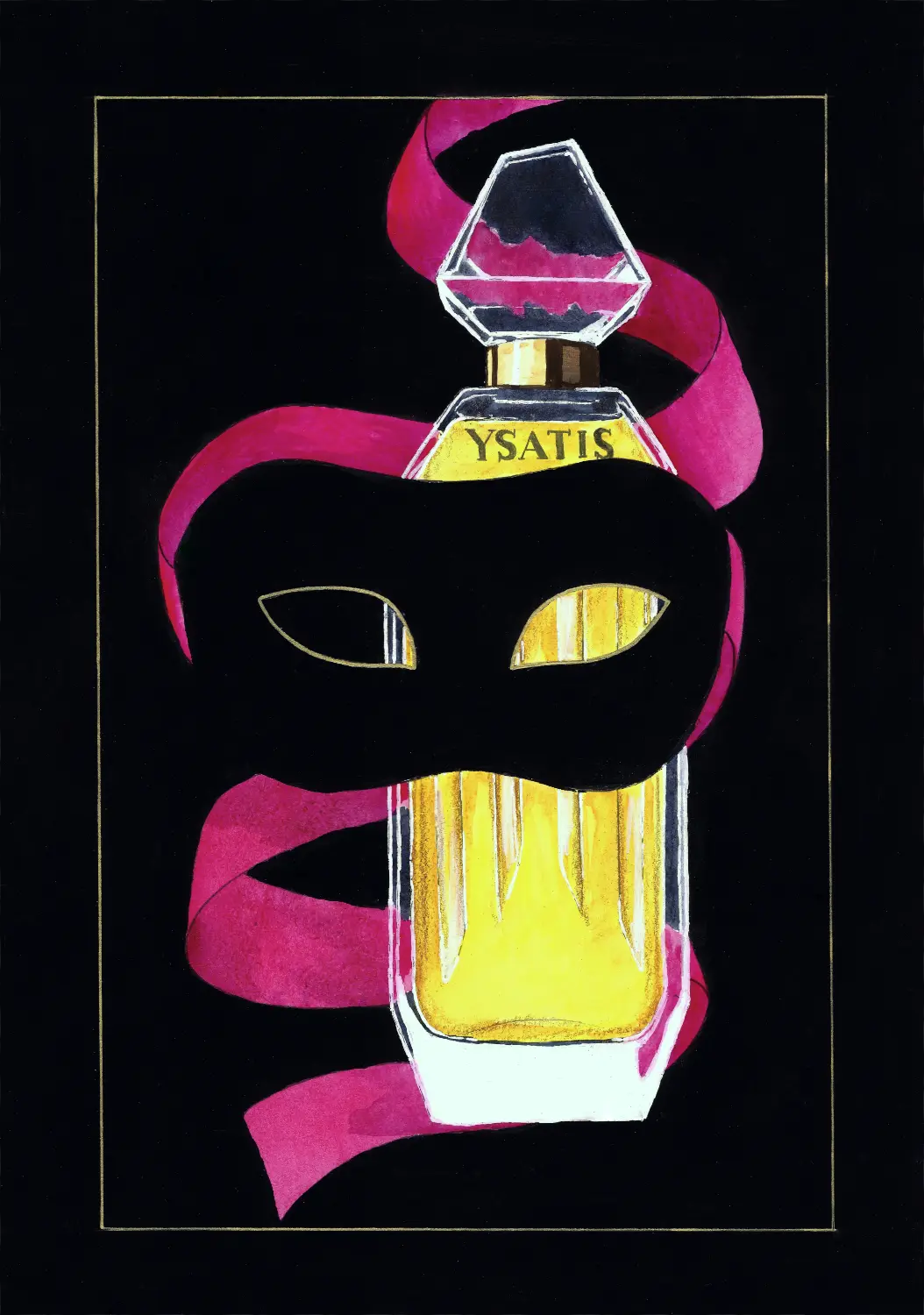
In the midst of the chaos, a woman in a simple black gown, wearing a markedly simple black mask, enters the room. Her presence is noticed by everyone, but none of them dare to speak to her. Her gaze pierces the crowd as she searches for her pawn, and as she slinks, her mysterious name slips in hushed tones across the hall. You make eye contact with her and feel her focus tear through you like a knife.
Ysatis has arrived, and you are her prey.
Le De
Born in 1927 to a noble family, Hubert de Givenchy would get his start in the fashion industry in 1945. His first designs were for the French fashion house Jacques Fath, from there Hubert designed for a variety of houses.
After a number of years spent in the industry, Hubert would open his own house in 1952, Givenchy. Under his own eponymous label, Hubert’s attention to detail, elegantly refined designs, and creative usage of materials brought him international acclaim and success.
His dedication to quality and the mastering of his craft solidified him as one of the greatest French designers in all of fashion history. That dedication not only extended to his fashion, but also into the world of fragrances as well.


During the interwar period, many of the great fashion houses began expanding their business ventures in novel ways. Products such as home goods, skincare, makeup, and, of course, fragrances were all new horizons just waiting to be explored by the designers of the day. Pioneering houses such as Chanel, Jean Patou, and Lanvin found great success in these avenues, and even helped keep them afloat during the Great Depression.
Following the end of the war, dozens of new fashion houses opened across Europe, and a great many chose to launch fragrance lines as well. The result was an explosion and true establishment of “designer” fragrances, a market that makes up a large portion of fragrance sales to this day.
Keeping pace with his contemporaries, Givenchy soon also launched fragrances to accompany his fashion line. Le De, L’Interdit, and in 1970 III would all be tremendous successes for the company and establish them as a force to be reckoned with. Ysatis would continue that pattern, but in a much bolder way.
Each decade has its own style and culture that surrounds it, and the 1980s were no different. A western economic boom fueled by yuppies climbing the corporate ladder and riding the waves of stock market success, led to luxury and excess being taken to their utmost extremes. Revolutionary technologies became accessible to the public and brought with them new musical styles, desktop computers, and new design abilities. Reflecting this, the fashion industry reacted with larger than life silhouettes, flashier jewelry, and bolder colors and textile choices to match. More was more.
In reaction to these trends, the fragrance world saw equally massive hit releases that took the world by storm. Bright, radiant, incandescent compositions such as Poison and Giorgio would launch with their own spotlights affixed to them. Rich, dense, spicy fragrances such as Coco and Obsession would follow in the wake of the game changing Opium. Each of these compositions would bathe their wearers in a decadence that had not been seen (or smelt) in decades.
A new and young perfumer named Dominique Ropion would have undoubtedly been inspired by the same influences that shaped those scents. His response? Ysatis.
The Art of Seduction
In the 40+ years following Ysatis’s original release in 1984, the composition has undergone numerous reformulations and adjustments.
In my collection, I have three bottles of Ysatis, two vintage and one modern.
On the vintage side, I have a spray Eau de Toilette from 1992 and a parfum bottle from 1985. The modern is the most recent reformulation, my bottle’s batch is from 2022.
For this review, I will be using my 1985 parfum.


As Ysatis touches your skin, the piercing gaze becomes a olfactory sensation.
Instead of the typical wall of density found in other compositions of its time, Ysatis‘s wiles creep up on you like a black cat in the night. The first wounds come in the form of a menagerie of bright and effervescent citrus notes. On my skin, i pick up notes of bergamot, orange, and the slightest hint of neroli. These are rounded out by a combination of a radiant and sunny ylang-ylang, with a hint of a smooth and milky coconut. When the two combine, they form a refined and creamy bond that bears a striking resemblance to other tropical notes, such as banana. Altogether, the opening of Ysatis serves as a vessel to ease you into her dark and moody embrace.
As you lose yourself in her black satin gown, the soothing rhythm of her heartbeat and floral bouquet wraps itself around you. Alive and dynamic, the beating pulse meshes and envelops each petal around you. The first note I notice is the combination of a very indolic jasmine, mixed with a very rich and slightly herbal rose. Not too dissimilar to Patou’s Joy, both compositions share the heft and weight these two flowers can offer. Ysatis, however, runs with the idea. Immediately bracing these two notes are a green-tinged tuberose, and a sweetened gardenia. Together, the two bring the radiance of the opening citrus-yellow floral hybrid deeper into the composition. Juxtaposing this white floral bouquet, a warm and spicy carnation adds a fire and passion to the arrangement. Ysatis‘s floral heart has a freshness to it that is often lacking in other compositions of its time. It is like a very structured and well groomed garden, with each plant having its own place to thrive and shine. When they come together though, they create a cocoon of olfactory bliss.
Once inside the cocoon, the mask slips off and Ysatis goes in for the kill. The lush floral bouquet is quickly replaced with a chypre-animalic base that is equal parts sultry and dangerous. On one side, the rich earthy notes of an wet and inky oakmoss mixed with the warm smolder of patchouli ground the entire composition. On the other side, a raw and fierce combination of civet and castoreum reveal the predator within. Two different sides of the same coin that work together to create a provocative and mesmerizing base.
It is easy to write Ysatis off as a relic of the past, another overly decadent and oppressive 1980s composition. In some ways that assumption is not incorrect, but it misses what lies behind that sparkling veneer. Ysatis is not the electric floral that Dior’s Poison can be, nor is it the spicebomb that Opium is. Ysatis walks a hidden path between the two, and on that path it picks up the notes of an older school of perfumery. Raw unbridled animalics, unapologetically lush florals, and punchy earth notes are all more reminiscent of fragrances from the “Golden Age” of perfumery. The green medicinal quality of Vol de Nuit, the luxury of Joy, and the sultry mystere of Rumeur are all found in Ysatis’s architecturally sculpted bottle. Ysatis is a 1930s old Hollywood star that has been reborn into the glitz and glamour of the 1980s, and she is all the better for it. A siren that has a shocking amount of depth and character beneath that perfectly glossy and refined exterior.
A silent assassin in a sea of loud bullies.
The Unmasked
Ysatis is a fragrance that really seems to capture any era it finds itself in. On one hand, it is a very 1980s composition that held its ground against its contemporaries. On the other, it’s ties to the past have earned it a sort of classical pinache that keeps it relevant decade after decade. That quality in Ysatis is really what brings me back to it time and time again, and is why it is my most worn scent in my entire collection.
On a side note, I want to mention how the modern formulation compares to my vintages. I truthfully wear the modern the most often, but it is different. I find that the modern is more smoothed out and refined, it has a heavier patchouli, and loses the animalic edge. The vintage in comparison is much more naughty in its animalics, and has a heavier punch behind it. That being said, the modern still smells like Ysatis and is easier to wear in a modern environment.
As always, thank you for reading, and I encourage you to share your thoughts down below.
Until next time,
– Zak
Related
-
Givenchy Ysatis – The Mask of Decadence
“Luxury is in each detail.” – Hubert de Givenchy Behind a wall of perfectly polished cuts of crystal, the flickering flame of hundreds of candles illuminate the grand ballroom in a baroque manor. Their warm light bounces off each tiny shard, and cascades their golden radiance down the intricate gilt work that adorns every inch…
-
Molinard Habanita – A Night in Havana
“Cuba is such a beautiful country, and everywhere you go, there’s music and people dancing – especially in Havana” – Julia Sawalha On a late spring day in interwar Paris, a blanket of warm golden rays washes across the city streets. The machine-like rhythm of the city begins to lull, as the inhabitants end their…
-
Dior Dune – The Sands of Time
“Perfume is a mark of female identity and the final touch of her style.”– Christian Dior A large, open, tranquil seaside beach extends in front of you to the horizon. Decades ago, its shifting sands were enjoyed by countless visitors enjoying the sun. Now, it sits empty, having been left behind for more interesting or…
Leave a Reply